







Semiconductor water treatment purifies incoming water to ultrapure standards and treats contaminated wastewater before discharge or reuse.
Chip manufacturing depends on this purity. Even trace particles, ions, or organic compounds in process water can damage wafers during etching and rinsing, reducing yield.
AXEON Water Technologies engineers and manufactures membrane filtration systems and components, while AXEONSupply.com gives fabs and their suppliers across the USA and Canada direct access to this catalog.
This guide covers the full picture semiconductor fabs need: water purification, wastewater treatment, and the industry standards governing both sides of the process.
What Is Semiconductor Water Treatment?
Semiconductor water treatment is the process of purifying incoming water to ultrapure levels while treating contaminated process wastewater before it is discharged or reused.
It relies on two connected systems working together. One system prepares water for the semiconductor fab. The other system manages what leaves it under a dedicated treatment plan.
Most content online addresses only one side of this equation. A semiconductor fab needs both handled under a single water treatment strategy, not two disconnected plans.
Intake-side water quality and discharge-side compliance are governed by different standards, but both determine whether a fab stays productive and compliant with its treatment obligations.
Consider a fab expanding capacity under new construction. It typically needs to scale ultrapure water supply and wastewater discharge systems together, rather than treating them as separate problems solved by separate vendors.
Why Chip Manufacturing Requires Ultra-High Water Purity
Ultrapure water must reach 18.2 MΩ·cm resistivity at 25°C, with total organic carbon below 1 part per billion. Particle counts must stay under 1 particle per milliliter for particles larger than 0.05 microns. These water quality thresholds come from the SEMI F63 standard.
This purity level matters most during chemical mechanical planarization, the polishing step that flattens wafer surfaces between fabrication layers in semiconductor manufacturing. A stray particle at this stage can damage a wafer and lower yield across a production run.
What Contaminants Threaten Semiconductor Manufacturing Water?
Water used in semiconductor manufacturing faces four contaminant categories: particulates, dissolved gases, organic compounds, and ionic species.
Particulates come from piping, storage tanks, and ambient dust that enters the water supply before treatment begins. Even sub-micron particles can lodge on a wafer surface during rinsing and go undetected without proper monitoring.
Dissolved gases, such as oxygen and carbon dioxide, alter water chemistry during processing steps and must be removed through degasification before the water reaches the tool.
Organic compounds, including solvents and photoresist residue, leave carbon traces in the water that show up as elevated TOC readings above spec.
Ionic species such as sodium, calcium, and trace metals conduct electricity and disrupt sensitive semiconductor circuits at the wafer level if left untreated.
How Contamination Impacts Chip Yield
Advanced nodes below 7nm tolerate very little contamination during semiconductor manufacturing. A single particle, ion, or trace metal introduced during the rinse or etch stage can render a wafer batch unusable.
This is why many fabs treat water purity as a yield metric rather than a compliance checkbox. An excursion in feedwater quality can carry a direct, measurable cost in scrapped wafers, delayed schedules, and lost production time.
What Water Treatment Technologies Are Used in Semiconductor Manufacturing?
Semiconductor manufacturing water relies on a coordinated treatment train: RO systems, ion exchange, UV disinfection, chemical dosing systems, and pretreatment filtration working together in sequence.
Each system removes a different category of contaminant from the water supply. No single technology can take incoming water from source quality to ultrapure standards on its own, which is why the treatment train exists as a whole.
AXEON Water Technologies engineers and manufactures this equipment, and AXEONSupply.com gives fabs and their engineering partners a single source for the systems and components involved, alongside select third-party equipment.
Reverse Osmosis (RO) Membrane Systems
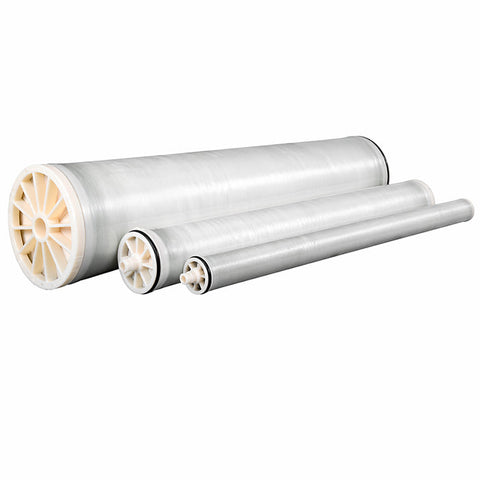
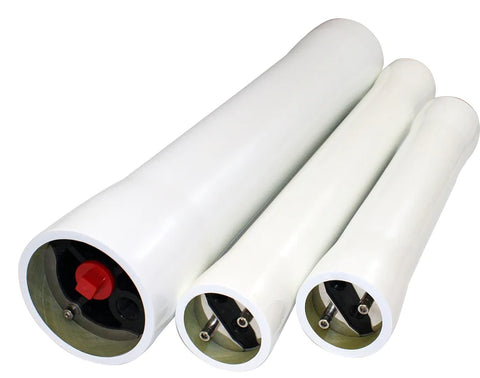
Reverse osmosis forces water through a semipermeable membrane under pressure, reducing dissolved salts, ions, and many organic compounds before further polishing; rejection varies by membrane type and operating conditions. AXEONSupply.com offers industrial RO systems and RO membranes that serve as the primary desalination step in most semiconductor water treatment trains, reducing the load on downstream stages.
Ion Exchange and Electrodeionization (EDI) Systems
Ion exchange and electrodeionization systems polish water after reverse osmosis, removing remaining dissolved ions to help reach the resistivity levels fabrication requires. This step typically depends on adequately pretreated RO permeate. AXEONSupply.com offers deionization and electrodeionization systems for this polishing stage before water reaches the fab.
UV Disinfection and Chemical Dosing Systems
UV disinfection inactivates susceptible microorganisms and can help control organic carbon, without adding chemical residue to the treatment stream. Because UV leaves no residual protection, downstream storage and distribution require proper design to limit regrowth. Chemical dosing systems inject antiscalants and other treatment chemicals that help protect membranes from fouling and scaling; cleaning chemicals are typically introduced during scheduled clean-in-place cycles rather than continuous dosing. AXEONSupply.com offers both disinfection systems and chemical injection systems for this stage of treatment.
Sediment Filtration, Softening, and Pretreatment
Sediment filters, water softeners, sand filters, storage tanks, and flow control valves prepare raw water before it reaches the RO membrane. This pretreatment stage helps protect downstream systems from fouling and supports membrane service life.
What Is Ultrapure Water (UPW) and Why Does It Matter?
Ultrapure water is the output of the complete semiconductor treatment train, produced through makeup, primary, and polishing systems working in sequence to reach final specification.
This ultrapure output must meet strict water quality parameters before it touches a wafer. Anything less introduces contamination risk into every process step that follows, from etching through final rinse.
The primary system removes bulk dissolved solids from the water through reverse osmosis and ion exchange. The polishing system then refines the water further, pushing resistivity and organic carbon content to their ultrapure target.
Resistivity must reach 18.2 MΩ·cm at 25°C, with TOC held below 1 part per billion. Advanced nodes push this further still, requiring ultrapure water with total organic carbon below 0.5 ppb in some fabrication processes.
How Is Semiconductor Wastewater Treated?
Semiconductor wastewater treatment removes process contaminants such as TMAH, trace metals, and slurry residue from water before it is discharged or reused.
This wastewater is distinct from feedwater purification but connected to it under the same overall treatment strategy. What a fab discharges is regulated separately from what it draws in.
Discharge limits are set through permits and vary by jurisdiction, receiving system, and pollutant. Fabs that fail to meet their permit conditions can face fines, corrective action, or production disruptions.
The process typically combines physical, chemical, and biological stages, depending on the wastewater stream and the specific water source involved.
Water Recovery, Reuse, and Zero Liquid Discharge (ZLD)
Water recovery reduces a fab's freshwater demand by reclaiming wastewater for reuse in non-critical processes across the site. Zero liquid discharge takes this further, eliminating liquid wastewater output entirely from the operation.
ZLD systems concentrate the remaining wastewater stream toward a solid residue, supporting some of the strictest reuse and sustainability targets a fab can set. This approach can help plant operations teams meet water-efficiency and discharge-reduction goals they report to corporate leadership and regulators.
What Standards Govern Semiconductor Water Quality?
SEMI F63 is the primary standard governing semiconductor water quality, defining the resistivity, TOC, particle count, and bacteria thresholds that ultrapure water must meet.
According to SEMI F63, resistivity must reach 18.2 MΩ·cm at 25°C. Total organic carbon must stay below 1 part per billion, with particle counts under 1 particle per milliliter for particles larger than 0.05 microns.
Bacteria levels must remain below 0.1 CFU per milliliter. Many fabs across the semiconductor industry reference these thresholds when specifying equipment and qualifying suppliers.
How Do You Choose the Right Semiconductor Water Treatment System?
Choosing the right semiconductor water treatment system starts with sizing to actual flow rate and purity specification, not generic equipment ratings from a catalog.
Source water varies by site. Systems that perform well in one location may foul more quickly in another with different mineral content, so pretreatment should be matched to local water chemistry.
Membrane fouling and replacement cadence can affect uptime. Fabs should evaluate parts availability and lead times before committing to specific systems, since a delayed membrane shipment can disrupt production.
Fab expansion changes requirements over time. Systems sized for current capacity ideally have a path to scale as production ramps, reducing the need for a full redesign of installed treatment.
Procurement structure matters too, particularly for semiconductor facilities under tight construction timelines. Some projects benefit from a single-vendor approach that reduces coordination between multiple suppliers, while others rely on an EPC firm managing several specialized systems under one project scope.
Why Work With AXEON Supply for Semiconductor Water Treatment Systems?
AXEON Water Technologies engineers and manufactures membrane filtration systems and components, and has served the water treatment industry since 1989. AXEONSupply.com gives fabs and their engineering partners across the USA and Canada direct access to this catalog.
The catalog covers the full semiconductor treatment train: reverse osmosis systems, electrodeionization, UV disinfection, chemical injection, and filtration for pretreatment.
AXEON provides complimentary technical support for current products within the applicable warranty period, including presale sizing, product selection, startup assistance, and operational troubleshooting. Custom-engineered configurations may be available for fabs with non-standard chemistry or space constraints.
Facilities weighing water quality across multiple applications can also see how these same principles apply in food and beverage water filtration, another industry where purity requirements drive equipment selection.
Request a quote or speak with a specialist to size the right solution for your facility's specific requirements.