





6 primary factors determine the lifespan of commercial reverse osmosis membranes, with a standard service range of 2–5 years under normal commercial operating conditions and up to 7 years with optimized system design. Thin-film composite (TFC) membranes — the commercial RO industry standard — deliver 30–40% longer service life than cellulose acetate (CA) membranes under equivalent feedwater conditions. These 6 factors govern that lifespan:
- Feedwater quality and TDS concentration
- Operating pressure and flux rate
- Fouling type — biological, colloidal, or mineral scaling
- Pre-treatment system effectiveness
- System recovery rate
- CIP (Clean-in-Place) cleaning frequency
How Does Feedwater Quality Affect RO Membrane Lifespan?
Feedwater TDS concentration is the single greatest determinant of commercial RO membrane lifespan — membranes operating on feedwater above 500 mg/L TDS show a lifespan reduction of up to 30% compared to membranes on feedwater below 100 mg/L TDS.
4 specific feedwater contaminants accelerate membrane degradation in commercial systems:
- Hardness minerals (CaCO₃, BaSO₄) — form crystalline scale deposits on the membrane active layer, blocking permeate flow
- Iron — precipitates as iron oxide on the membrane feed surface, causing irreversible colloidal fouling
- Free chlorine above 0.1 ppm — causes irreversible oxidative hydrolysis of TFC polyamide membrane active layers, the material used in 90%+ of commercial RO elements
- SDI (Silt Density Index) above 5 — indicates suspended particle loading that blocks membrane feed spacers within weeks of operation
Commercial facilities in Texas, Arizona, and California's Central Valley operate on high-hardness groundwater with TDS levels of 500–2,000 mg/L. Without antiscalant dosing, membrane lifespan in these regions compresses to 2–3 years.
How Do Operating Pressure and Flux Rate Shorten Membrane Life?
Operating a commercial RO membrane above its design net driving pressure (NDP) causes irreversible membrane compaction — a structural compression of membrane layers that permanently reduces water permeability.
Sustained flux rates above 20 GFD on standard 8040 commercial elements accelerate compaction and increase pump energy draw by 10–25%. Pressure surges during system start-up above 150–225 psi on commercial brackish elements cause mechanical damage to the membrane's feed spacer and glue line.
Each commercial RO membrane element carries a rated NDP range. AXEON SUPPLY's Made in USA membrane elements — including low-energy commercial series rated at 150 psi with 99.5% nominal salt rejection — deliver rated service life only when operated within specified NDP limits.
What Types of Fouling Reduce RO Membrane Lifespan?
4 distinct fouling mechanisms reduce commercial RO membrane lifespan — each requiring a different chemical cleaning response:
- Biofouling — Bacterial biofilm accumulates on the membrane feed surface, increasing differential pressure by up to 40% and reducing normalized permeate flow
- Colloidal fouling — Suspended particles (silica, iron oxide, clay) block membrane feed spacers, raising feed channel pressure drop and accelerating mechanical fiber stress
- Mineral scaling — CaCO₃ and BaSO₄ crystals deposit on the membrane active layer when system recovery exceeds concentration limits; CaCO₃ scale develops within 48–72 hours in untreated high-hardness feedwater
- Chemical degradation — Oxidizing agents (free chlorine >0.1 ppm, ozone) and feedwater pH below 2 or above 11 irreversibly hydrolyze TFC polyamide membrane active layers
CIP cleaning is indicated when normalized permeate flow drops 10%, differential pressure increases 15%, or normalized salt rejection drops 10% from commissioning baseline.
How Does Pre-Treatment System Quality Extend Membrane Life?
Pre-treatment system effectiveness is the most controllable determinant of commercial RO membrane lifespan — a correctly sized pre-treatment train extends membrane service life from 2–3 years to 5–7 years under identical feedwater conditions.
3 pre-treatment components directly protect membrane service life:
- 5-micron sediment pre-filtration — reduces SDI loading at the membrane inlet below the 5.0 threshold
- Carbon block pre-filtration — removes free chlorine before contact with TFC polyamide membrane active layers
- Antiscalant chemical dosing — suppresses CaCO₃ and BaSO₄ crystallization at the membrane surface during high-recovery operation
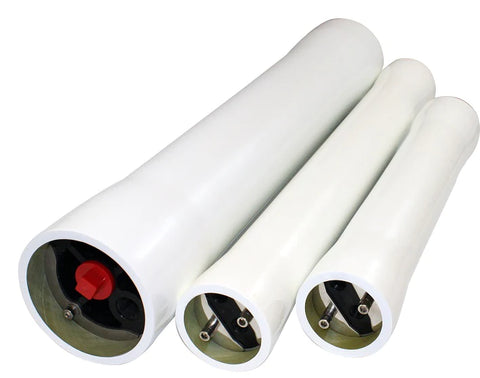
AXEON SUPPLY stocks sediment pre-filter cartridges, carbon block filters, and membrane housings compatible with 4040 and 8040 commercial RO elements — maintaining pre-treatment specifications throughout a membrane's rated service life.
What Recovery Rate Accelerates RO Membrane Degradation?
Operating a commercial RO system above 75–85% recovery accelerates concentration polarization at the membrane surface, increasing mineral scaling rates and reducing membrane service life by 20–35%.
Concentration polarization at elevated recovery rates raises local TDS concentration at the membrane feed surface to 3–5× the bulk feedwater TDS — exceeding scaling thresholds even when bulk feedwater TDS remains within acceptable limits.
The standard design recovery target for single-pass commercial brackish water RO systems is 50–75%.
How Often Does CIP Cleaning Extend Commercial RO Membrane Life?
CIP (Clean-in-Place) cleaning performed at correct intervals extends commercial RO membrane service life by 30–50% compared to systems operating without a preventive cleaning schedule.
CIP frequency varies by application and fouling risk:
- Food & beverage and wastewater recycle systems — CIP every 30 days
- Standard commercial and industrial systems — CIP every 90 days
- Low-fouling municipal feedwater systems — CIP every 6 months
AXEON SUPPLY stocks CIP skid accessories and membrane cleaning chemical kits compatible with all standard 4040 and 8040 commercial RO elements — supporting preventive CIP schedules across all 3 application categories.
What KPIs Indicate a Commercial RO Membrane Needs Replacement?
4 measurable KPIs indicate a commercial RO membrane reaches end-of-service life:
- Salt rejection rate below 93% — standard commercial TFC membranes operate at 98–99.5% nominal salt rejection; a drop below 93% signals irreversible membrane degradation
- Normalized permeate flow decline of 20%+ from commissioning baseline — indicates irreversible fouling or compaction unrecoverable by CIP cleaning
- Differential pressure increase of 15%+ above baseline — signals severe biofouling or colloidal fouling in the membrane feed channel
- Salt passage increase of 10%+ from baseline — indicates active layer breach or physical membrane damage
Feedwater quality, operating pressure, fouling type, pre-treatment effectiveness, recovery rate, and CIP frequency are the 6 factors that determine whether a commercial RO membrane reaches or falls short of its rated 2–5 year service life.
Commercial RO membrane lifespan is determined by 6 measurable, controllable operational factors — not by time alone. Feedwater TDS concentration, operating pressure, fouling type, pre-treatment system quality, system recovery rate, and CIP cleaning frequency collectively decide whether a commercial RO membrane delivers 2 years or 7 years of service life.
AXEON SUPPLY supplies the parts and accessories that directly support each of these 6 factors — including Made in USA RO membrane elements, sediment pre-filter cartridges, carbon block filters, membrane housings, CIP skid accessories, and cleaning chemical kits compatible with standard 4040 and 8040 commercial RO elements across the United States.
Explore AXEON SUPPLY's commercial RO membrane parts and accessories catalog to maintain rated membrane service life at every stage of your system's operation.