





Reverse osmosis removes dissolved solids, organics, bacteria, and viruses using a semipermeable membrane under pressure. Deionization removes charged ions using ion exchange resin, but it does not remove organics or microorganisms on its own. The right choice depends on your required purity level and application.
AXEON Supply has more than three decades of experience engineering and manufacturing membrane filtration systems and components for industrial, commercial, and laboratory water treatment.
This guide compares reverse osmosis (RO) and deionization (DI) water purification directly. It covers how each process works, what each removes, when to use RO alone, DI alone, or both together, and which system components support each water treatment technology.
What Is Reverse Osmosis Water Purification?
Reverse osmosis is a physical filtration process that forces water through a semipermeable membrane under pressure. The membrane substantially reduces dissolved solids, organic compounds, bacteria, and viruses, though actual rejection rates vary by membrane type, feedwater chemistry, pressure, and system condition.
Reverse osmosis systems typically operate at pressures between 80 and 350 psi, depending on feed water salinity and system design.
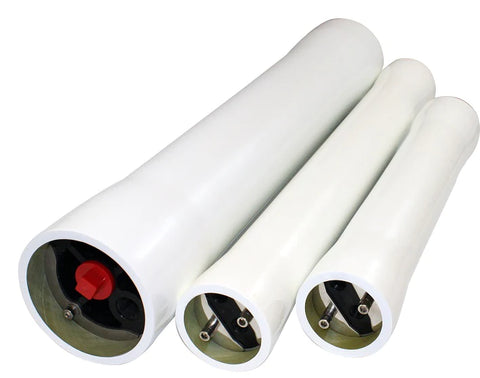
A typical RO train includes three stages. Prefiltration through a sediment cartridge protects the membrane from particulate fouling. The semipermeable membrane element itself is housed in a pressure vessel. Post-treatment, such as carbon polishing, follows.
RO membranes are the core component of this process. An RO membrane is a spiral-wound filtration element, typically constructed from polyamide thin-film composite, that rejects a high percentage of dissolved solids while allowing purified water molecules to pass.
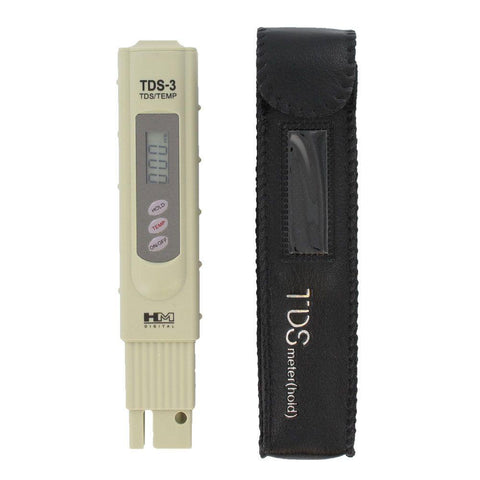
An RO water filtration system also reduces total dissolved solids (TDS), the combined measure of minerals, salts, and organic matter dissolved in feed water. Because the process works by physical membrane filtration rather than chemical exchange, an RO system requires no regeneration chemicals during normal operation, only periodic membrane and prefilter replacement.
Reverse osmosis commonly reduces water conductivity to a range of roughly 1 to 50 microsiemens per centimeter, depending on feed water quality and membrane condition. This purity level suits food and beverage production, pharmaceutical manufacturing, general industrial processing, and drinking water applications where broad contaminant reduction meets the requirement.
What Is Deionization Water Purification?
Deionization is a chemical process that removes dissolved ions from water using ion exchange resin. A well-maintained DI system can achieve conductivity below 1 microsiemens per centimeter, representing near-complete removal of ionic content.
The resin bed exchanges positively charged ions, such as calcium, magnesium, and sodium, for hydrogen ions. It exchanges negatively charged ions, such as chloride and sulfate, for hydroxide ions. The hydrogen and hydroxide ions combine to form pure water molecules.
A deionization system consists of one or more resin-filled vessels, a regeneration system using acid and caustic chemicals to restore resin capacity once it becomes exhausted, and conductivity monitoring equipment to confirm output purity.
Unlike reverse osmosis, deionization does not remove organic compounds, bacteria, viruses, or particulates. It targets dissolved ions exclusively.
Water softeners use a related ion exchange mechanism but serve a different purpose than deionization. A water softener exchanges hardness minerals, specifically calcium and magnesium, for sodium ions to reduce scale formation. It does not remove other dissolved solids and does not achieve the low conductivity that deionization produces. Water softeners are typically installed ahead of an RO system as pretreatment, not as a substitute for DI.
A DI water system measures output purity by conductivity and resistivity rather than by a percentage reduction in dissolved solids, since deionization is designed to remove nearly all ionic material rather than reduce it proportionally.
Deionized water serves laboratory applications, electronics manufacturing, pharmaceutical compounding, and other processes requiring near-complete mineral removal with lower energy input, since DI systems typically require less operating pressure than RO.
What Is the Difference Between RO and DI Water Purification?
Reverse osmosis uses physical membrane filtration to reduce dissolved solids, organics, and microorganisms. Deionization uses chemical ion exchange to remove charged ions. The two technologies address different water treatment problems and are frequently used together for applications requiring both broad contaminant removal and low conductivity.
Purity and Conductivity Comparison
The table below summarizes typical performance ranges. Actual results depend on feedwater quality, system design, and maintenance.
| Parameter | Reverse Osmosis | Deionization |
|---|---|---|
| Typical purity level | Substantial reduction of dissolved solids, organics, and microorganisms | Near-complete removal of dissolved ions |
| Conductivity | Roughly 1 to 50 microsiemens per centimeter | Typically below 1 microsiemens per centimeter |
| Mineral removal | Partial, varies by membrane and feedwater | Near-complete for ionic content |
| Organics and microorganism removal | Yes, substantially reduced | No |
| Operating pressure | 80 to 350 psi | Low pressure, gravity or minimal pump feed |
| Energy usage | Higher | Lower |
Contaminant Removal Comparison
Reverse osmosis reduces dissolved solids, organic compounds, many metals, bacteria, and viruses, with rejection rates that vary by membrane type and operating conditions.
Deionization removes charged ions such as calcium, magnesium, sodium, chloride, and sulfate. It does not remove organic molecules, bacteria, or viruses.
This is the most important distinction when selecting a system. DI water can be nearly ion-free and still carry microbial contaminants if not paired with RO, UV disinfection, or another microbial barrier.
Cost and Maintenance Comparison
RO systems require membrane and prefilter replacement, commonly every 1 to 2 years depending on feed water quality and usage volume.
Periodic membrane cleaning using antiscalant and cleaning chemicals helps control fouling between replacements.
DI systems require resin regeneration or full resin replacement, commonly every 3 to 5 years in moderate-use applications, using acid and caustic regeneration chemicals. RO water treatment systems generally consume more energy due to continuous high-pressure pump operation, while DI systems have lower energy costs but higher chemical handling requirements during regeneration.
Ongoing costs for either water filtration system depend heavily on incoming water quality. Testing feed water total dissolved solids and hardness before sizing either system, or a combined RO-DI water system, helps prevent undersized components and reduces long-term service costs.
When Should You Use Reverse Osmosis vs. Deionization?
Use reverse osmosis when your application requires broad contaminant removal, including organics and microorganisms. Use deionization when your application requires near-complete mineral removal and can tolerate its inability to remove organics or microbes on its own.
Industrial and Manufacturing Applications
Reverse osmosis commonly serves food and beverage production, pharmaceutical manufacturing, and general chemical processing, where broad contaminant removal meets process and quality requirements in industrial water treatment settings.
Deionization commonly serves electronics manufacturing and precision parts cleaning, where trace mineral deposits can cause circuit failures or surface defects that RO alone may not prevent. Semiconductor fabrication in particular often requires DI water with resistivity approaching 18 megohm-centimeters, a purity level RO alone cannot reach without a DI polishing stage.
Laboratory and Medical Applications
Deionization is often used to produce the ultra-pure water required for analytical testing, chromatography, and research applications, typically after RO pretreatment removes organics and microorganisms first.
Reverse osmosis alone can support dialysis water treatment, sterilization processes, and general laboratory rinsing where DI-level ionic purity is not required. Facilities should confirm water quality requirements against the specific standard that applies to their equipment and process, since laboratory and medical water specifications vary by application.
Power Generation Applications
Deionization is often used to help produce the low-conductivity water required for boiler feed water and cooling systems, where mineral scale can damage high-pressure equipment.
Reverse osmosis pretreatment can remove bulk dissolved solids first, which may extend the service life of DI resin and reduce regeneration frequency during the treatment process. Required feedwater quality typically becomes more stringent as boiler operating pressure increases, making the RO-DI combination more common at higher-pressure facilities.
Can Reverse Osmosis and Deionization Be Used Together?
Yes. Combining reverse osmosis and deionization in sequence, with RO first and DI second, is standard practice for applications requiring very low conductivity.
RO removes the bulk of dissolved solids, organics, and microorganisms first. DI then polishes the remaining trace ions to help achieve conductivity below 1 microsiemens per centimeter.
Sequencing matters. Placing DI before RO exposes the resin bed to the full ion load of untreated feed water, which can exhaust the resin faster and increase regeneration frequency and chemical cost.
RO first sequencing helps protect the DI resin and can lower total system operating cost. Combined RO DI systems are common in semiconductor manufacturing, pharmaceutical compounding, laboratory grade ultrapure water production, and power generation boiler feed applications.
Facility teams sizing a combined system should evaluate feed water quality, required output conductivity, and flow rate together, since undersizing either the RO or DI stage can shift the purification burden onto the other and shorten component service life.
AXEON manufactures both Reverse Osmosis Systems and Deionization Systems, including Electrodeionization Systems for continuous ion removal without chemical regeneration. AXEON's DI systems can be configured as standalone units or paired with RO pretreatment depending on the application.
What System Components Support RO and DI Water Treatment?
A complete RO or DI water treatment system depends on pretreatment, monitoring, and post-treatment components working together, not the membrane or resin bed alone. AXEON manufactures and supplies component options for these systems.
Pretreatment Components
Sediment filters and sand filters remove particulate matter before it reaches the RO membrane or DI resin bed, helping prevent fouling that can reduce system efficiency and shorten component service life. Each filter is sized to the feed water's particulate load and the flow rate it needs to support.
Water softeners reduce hardness minerals ahead of RO to help prevent scale buildup on the membrane surface.
Chlorination systems help control microbial growth in feed water, but chlorine must be removed through carbon filtration before contacting most RO membrane materials, since chlorine exposure can degrade polyamide membranes.
Monitoring and Control Components
Flow control valves regulate feed pressure and flow rate through RO membranes and DI vessels to help maintain consistent output quality across the water system.
Storage tanks, available in pressurized and atmospheric configurations, hold treated water between purification stages or before end use.
Post-Treatment and Disinfection Components
UV disinfection provides an additional microbial control barrier after RO or DI water filtration treatment, particularly relevant for DI water, which does not remove bacteria or viruses on its own.
Chemical dosing systems deliver antiscalants ahead of RO membranes to help prevent scale formation, and deliver acid and caustic regeneration chemicals to DI resin beds during the regeneration cycle.
AXEON's technical support and parts service team can help match filter, membrane, and resin specifications to your existing water treatment system.
Why Choose AXEON for RO and DI Water Purification Systems?
AXEON Water Technologies has more than three decades of experience engineering and manufacturing membrane filtration systems and components.
AXEON Supply provides wholesale access to that product line for trade professionals across the United States and Canada.
AXEON manufactures American-made RO and DI systems and maintains an in-house technical support team available Monday through Friday, 7:30 a.m. to 4:30 p.m. Pacific time, for direct customers within the applicable product warranty period.
AXEON's catalog spans residential, commercial, and industrial reverse osmosis systems, deionization and electrodeionization systems, membrane elements, filter cartridges, filter housings, chemicals, and measuring and testing equipment, supplied through a wholesale account with trade pricing.
Beyond the initial system purchase, AXEON's parts and service catalog supports ongoing maintenance, including replacement membranes, resin, prefilters, and consumables sized to your existing RO or DI system.
Request a Quote to get pricing on RO systems, DI systems, or a combined solution sized to your application, or Become a Customer Today to access wholesale pricing on AXEON's filtration catalog.
Frequently Asked Questions About RO vs. DI Water Purification
Budget: 280-300 words (6 Q&A pairs). Target n-grams: difference between reverse osmosis, total dissolved solids.
What is the main difference between reverse osmosis and deionization?
Reverse osmosis uses a semipermeable membrane to physically filter out dissolved solids, organics, bacteria, and viruses. Deionization uses ion exchange resin to chemically remove charged ions, but it does not remove organics or microorganisms.
Which produces purer water, RO or DI?
Deionization typically achieves lower conductivity, often below 1 microsiemens per centimeter compared to roughly 1 to 50 microsiemens per centimeter for reverse osmosis. However, DI water is not necessarily safer or cleaner overall, since deionization does not remove organic compounds, bacteria, or viruses the way RO does.
Can DI water be used for drinking?
Deionized water is not generally recommended for regular drinking, since the deionization process does not remove bacteria, viruses, or organic contaminants, and DI water lacks the minerals that reverse osmosis water typically retains in small amounts. Reverse osmosis water is the more common choice for drinking water applications.
How often do RO membranes need to be replaced compared to DI resin?
RO membranes and prefilters commonly require replacement every 1 to 2 years, depending on feed water quality and usage volume. DI resin commonly requires regeneration or replacement every 3 to 5 years in moderate-use applications, though high-use or high-mineral-content applications may require more frequent regeneration.
Is a combined RO-DI system more expensive to operate?
A combined RO-DI system typically costs more to install than either technology alone. However, RO pretreatment can extend DI resin life and reduce regeneration frequency, which may lower the combined system's long-term operating cost compared to running DI alone on untreated feed water.
What is total dissolved solids (TDS) and why does it matter for RO vs DI?
Total dissolved solids (TDS) is the combined measure of minerals, salts, and organic matter dissolved in water. RO reduces TDS through physical membrane filtration, while DI removes the ionic portion of TDS through chemical ion exchange, without removing dissolved organics on its own.
Conclusion
Reverse osmosis and deionization solve different water purification problems. RO reduces a broad range of contaminants, including organics and microorganisms, using membrane filtration. DI removes charged ions using ion exchange resin, but requires a separate microbial barrier for complete water safety.
Many industrial, laboratory, and manufacturing applications combine both technologies in sequence to achieve low-conductivity, broadly purified water.
AXEON Water Technologies brings more than three decades of manufacturing experience to RO and DI system design, and AXEON Supply provides wholesale access to the component and accessory catalog needed to build, maintain, and monitor either solution. Contact AXEON to discuss which system, or combination, fits your water quality requirements.