


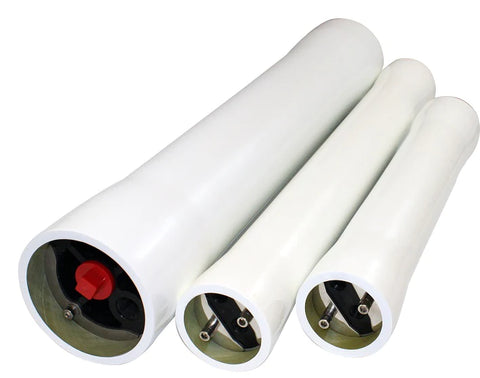

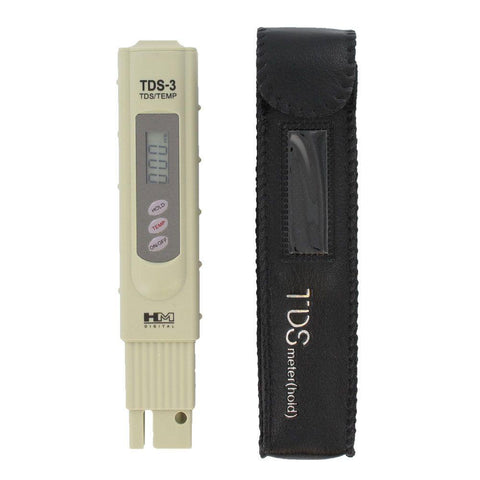


High-rejection RO membranes improve water quality performance by restricting dissolved ionic contaminants from passing into the permeate stream at nominal salt rejection rates of 99%–99.5%, measured at 500 mg/L NaCl, 77°F (25°C). Polyamide thin-film composite (TFC) construction enables this performance by creating a dense, semi-permeable active layer that blocks dissolved solids while allowing purified water molecules to pass through.
What Is Salt Rejection Rate in an RO Membrane?
Salt rejection rate is the percentage of dissolved ionic solids an RO membrane blocks from entering the permeate stream, calculated as: [(Feed TDS − Permeate TDS) ÷ Feed TDS] × 100.
Tap water RO membranes produce 3 nominal rejection tiers based on membrane construction and applied pressure:
- 98.5% — HF5-Series, 80 psi applied pressure
- 99% — HF1-Series and HF4-Series, 100–150 psi applied pressure
- 99.5% — HR3-Series, 225 psi applied pressure; the highest salt rejection tier in the tap water RO membrane category
How Does a Higher Rejection Rate Improve Permeate Water Quality?
A higher rejection rate directly reduces permeate TDS — at identical feed water TDS, each 0.5% increase in salt rejection rate halves the dissolved ionic solids passing into the permeate stream.
The table below shows calculated permeate TDS output across 3 AXEON tap water RO membrane series at 500 ppm feed water TDS, based on nominal salt rejection rates and corresponding salt passage values.
| Feed Water TDS | Rejection Rate | Salt Passage | Permeate TDS |
|---|---|---|---|
| 500 ppm | 98.5% (HF5-Series) | 1.5% | 7.5 ppm |
| 500 ppm | 99% (HF1/HF4-Series) | 1.0% | 5.0 ppm |
| 500 ppm | 99.5% (HR3-Series) | 0.5% | 2.5 ppm |
At 1,000 ppm feed TDS — typical of high-salinity municipal or deionization feed applications — the permeate TDS difference between 98.5% and 99.5% rejection doubles: 15 ppm vs. 5 ppm.
What Contaminants Do High-Rejection RO Membranes Reduce?
High-rejection RO membranes address 6 dissolved ionic and chemical contaminant categories through the polyamide thin-film composite layer's size exclusion and charge-based rejection mechanisms.
- Dissolved salts (sodium, calcium, magnesium, potassium ions) — rejected at nominal rates up to 99.5%
- Heavy metals (lead, arsenic, chromium) — blocked as multivalent ions through combined size and charge exclusion
- Nitrates and nitrites — rejected based on ionic charge and membrane selectivity
- Sulfates — rejected at rates exceeding 99% due to high ionic charge density
- Fluoride — removed through the polyamide membrane's charge-based exclusion mechanism
- Total dissolved solids (TDS) — the aggregate measure of all dissolved ionic content remaining in the permeate stream
Which Applications Require High-Rejection RO Membrane Performance?
4 primary application categories depend on high-rejection RO membrane performance for process quality or regulatory compliance, ordered by rejection threshold requirement.
- Deionization (DI) feed water pretreatment — HR3-Series at 99.5% rejection reduces DI resin loading by lowering permeate TDS input to downstream polishing stages
- Municipal water treatment — HR3-Series at 225 psi addresses high-salinity and elevated TDS municipal source water conditions
- Commercial and light industrial process water — HF1/HF4-Series at 99% rejection suits stable municipal feed water at 200–500 ppm TDS
- Low-energy commercial operations — HF5-Series at 98.5% rejection and 80 psi suits installations where energy savings take priority over maximum rejection performance
What Factors Affect High-Rejection RO Membrane Performance Over Time?
4 operational factors reduce effective salt rejection rate in high-rejection RO membranes over time.
- Feed water TDS above the tested threshold — all AXEON tap water RO membranes are tested at 500 mg/L NaCl; feed water TDS above this level increases salt passage proportionally
- Chlorine and chloramine exposure — polyamide TFC membranes carry 0 ppm chlorine/chloramine tolerance; oxidative contact with chlorine permanently degrades the active rejection layer
- Scaling and fouling — calcium carbonate, silica, and iron deposits on the membrane surface reduce active polyamide layer contact with feed water, lowering effective rejection rate
- Operating temperature below 77°F (25°C) — all AXEON membrane elements are tested at 77°F; feed water below this temperature reduces permeate flow rate and measured rejection performance
When normalized salt rejection (NSR) drops below 90% of the original rated value, membrane replacement restores permeate quality to specified rejection levels.
AXEON Supply—Membrane Elements for High-Rejection Applications
AXEON Supply stocks high-rejection RO membrane elements across multiple rejection grades. The HR3-Series delivers 99.5% nominal salt rejection for municipal water and deionization feed applications. The HF4-Series delivers 99% nominal salt rejection at 100 psi—made in the USA—for commercial tap water systems requiring low-energy operation.
Frequently Asked Questions
What Is Considered a High-Rejection RO Membrane?
A high-rejection RO membrane produces a nominal salt rejection rate of 99% or above, measured at 500 mg/L NaCl, 77°F (25°C) under standard test conditions. Membranes rated at 99.5% — such as the HR3-Series — represent the highest rejection tier in the tap water RO membrane category.
Does a Higher Rejection Rate Always Mean Better Water Quality?
For the same feed water TDS, a higher rejection rate directly produces lower permeate TDS. At 500 ppm feed water, a 99.5% rejection membrane produces 2.5 ppm permeate vs. 7.5 ppm from a 98.5% membrane — a 3× difference in permeate dissolved solids. Application requirements determine the minimum acceptable rejection threshold.
How Often Should High-Rejection RO Membranes Be Replaced?
High-rejection RO membranes require replacement when normalized salt rejection (NSR) drops below 90% of the original rated performance, or when permeate TDS rises above the baseline recorded at installation. Feed water quality, pre-treatment effectiveness, and chlorine exposure directly determine replacement frequency.