





Brackish water RO membranes improve industrial system efficiency by operating at 150–600 psi , 50–75% lower than seawater RO membranes , while delivering 99%+ salt rejection, water recovery rates of 60–85%, and energy consumption of 0.36–1.51 kWh/m³ per 1,000 gallons treated.
What Are Brackish Water RO Membranes?
Brackish water RO membranes are polyamide thin-film composite, spiral-wound membrane elements designed to treat feed water with TDS between 1,000 and 10,000 ppm at operating pressures of 150–600 psi. Brackish water RO membranes operate at 50–75% lower pressure than seawater RO membranes (800–1,200 psi) and at higher pressure than tap water RO membranes (50–150 psi), making brackish water RO membranes the correct specification for industrial groundwater and surface water sources with intermediate salinity levels. AXEON Supply's brackish water RO membrane elements use polyamide thin-film composite construction across all standard industrial sizes.
How Do Brackish Water RO Membranes Reduce Energy Consumption?
Brackish water RO membranes reduce energy consumption by operating at 150–600 psi , 50–75% lower than seawater RO membranes at 800–1,200 psi. Brackish water RO systems consume 0.36–1.51 kWh/m³, compared to seawater RO systems at 2.5–4.0 kWh/m³ , a 60–75% reduction in specific energy consumption per volume treated. According to the Texas Water Development Board, optimized brackish water RO configurations achieve specific energy consumption as low as 1.59 kWh/1,000 gallons in industrial groundwater treatment applications. Lower operating pressure directly reduces pump load, motor wear, and mechanical stress on fittings and housings across the entire industrial system. AXEON Supply's XE1 and XE3 Series brackish water RO membrane elements operate at 100 psi , the lowest energy tier in the brackish water RO membrane category , making brackish water RO membranes the highest-efficiency specification for industrial boiler feedwater and process water treatment systems.
What Water Recovery Rates Do Brackish Water RO Membranes Achieve?
Brackish water RO membranes achieve 60–85% water recovery in industrial systems , the ratio of permeate volume produced to feed water volume supplied. Increasing recovery from 60% to 80% on a 100,000 GPD industrial system reduces reject water discharge by 20,000 gallons per day, directly lowering wastewater disposal costs and municipal feed water consumption. Water recovery rates vary across 3 primary industrial applications:
- Industrial process water systems achieve 70–85% recovery with proper pre-treatment and antiscalant dosing
- Food and beverage CIP water systems achieve 50–75% recovery based on feed water TDS and seasonal temperature variation
- Pharmaceutical purified water systems achieve 65–80% recovery as the primary purification stage before polishing
Higher water recovery rates reduce operating costs across all 3 industrial applications without requiring additional membrane elements or system expansion.
How Does Salt Rejection Rate Affect Industrial System Efficiency?
Brackish water RO membranes deliver 99–99.5% nominal salt rejection, removing dissolved solids, heavy metals, and ionic contaminants from feed water with TDS between 1,000 and 10,000 ppm. Higher salt rejection produces lower permeate TDS, reducing the number of downstream polishing steps required , directly lowering total treatment cost per 1,000 gallons. Higher salt rejection reduces the load on downstream polishing equipment, potentially extending resin life and lowering operating costs. Salt passage in brackish water RO membranes increases 5–10% annually in active industrial systems, signaling scheduled replacement before permeate TDS exceeds process water quality thresholds. AXEON Supply's HR3-Series brackish water RO membrane elements deliver 99.5% nominal salt rejection for high-salinity industrial feed water applications up to 10,000 ppm TDS.
What Industrial Applications Benefit Most from Brackish Water RO Membranes?
Brackish water RO membranes deliver the highest efficiency gains across 4 primary industrial sectors:
- Power generation (boiler feedwater): Brackish water RO membranes reduce feedwater TDS to below 10 ppm, minimizing boiler scale formation and extending boiler tube service life
- Food and beverage processing: Brackish water RO membranes produce process water meeting FDA 21 CFR Part 110 standards, reducing re-treatment frequency and chemical consumption
- Pharmaceutical manufacturing: Brackish water RO membranes serve as the primary purification stage for USP Purified Water systems, achieving permeate TDS below 500 ppb before polishing
- Industrial wastewater reuse: Brackish water RO membranes recover 70–85% of treated effluent for direct process reuse, reducing municipal water purchase costs by 40–60%
Each industrial application requires a different membrane configuration , element size, salt rejection %, and operating pressure , matched to feed water TDS, daily volume requirements, and downstream process water quality standards.
How Do Brackish Water RO Membranes Compare to Seawater RO Membranes in Industrial Systems?
The following table compares brackish water RO membranes and seawater RO membranes across 5 critical performance dimensions for industrial system specification:
| Dimension | Brackish Water RO Membranes | Seawater RO Membranes |
|---|---|---|
| Operating Pressure | 150–600 psi | 800–1,200 psi |
| Energy Consumption (SEC) | 0.36–1.51 kWh/m³ | 2.5–4.0 kWh/m³ |
| Typical Water Recovery | 60–85% | 35–50% |
| Ideal Feed TDS Range | 1,000–10,000 ppm | 10,000–45,000 ppm |
| Nominal Salt Rejection | 99–99.5% | 99.4–99.8% |
Brackish water RO membranes are the correct specification for industrial groundwater and surface water sources with feed TDS below 10,000 ppm. Specifying seawater RO membranes on brackish water sources increases industrial system energy costs by 40–60% due to over-pressurization beyond the feed water's osmotic pressure requirements.
What Factors Reduce Brackish Water RO Membrane Efficiency Over Time?
3 primary factors reduce brackish water RO membrane efficiency in industrial systems:
- Scaling , calcium carbonate, calcium sulfate, and silica deposits at recovery rates above 80% increase operating pressure by 10–20% and reduce normalized permeate flow across the membrane element
- Biofouling , biofilm formation on the membrane surface increases differential pressure across the element by 15–30%, requiring clean-in-place (CIP) intervention before irreversible flux loss occurs
- Membrane aging , salt passage increases 5–10% annually in active industrial systems; normalized permeate flow decline of 10–15% signals irreversible membrane compaction and scheduled replacement
Antiscalant dosing and scheduled CIP cleaning with membrane-compatible chemical cleaners address scaling and biofouling directly. AXEON Supply carries antiscalants, antifoulants, and membrane cleaning chemicals engineered for brackish water RO membrane maintenance in industrial systems.
How Do You Select the Right Brackish Water RO Membrane for an Industrial System?
Brackish water RO membrane selection for industrial systems depends on 4 measurable parameters:
- Measure feed water TDS (ppm) and temperature (°F) to determine the required operating pressure range for the membrane element
- Calculate target water recovery rate (%) based on facility daily volume requirements and reject water disposal capacity
- Specify required salt rejection % based on downstream process water quality standards , boiler feedwater requires permeate TDS below 10 ppm; pharmaceutical purified water requires permeate TDS below 500 ppb
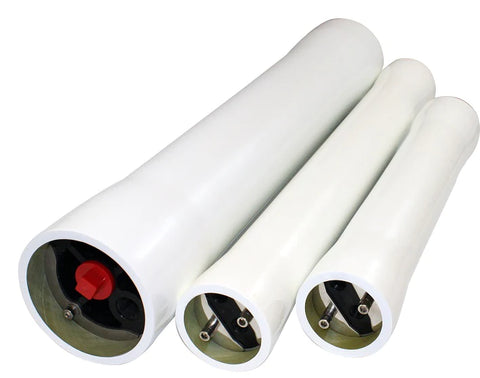
- Match membrane element size , 2.5-inch, 4-inch, or 8-inch , to system GPD requirement and existing housing configuration
Use 4040 elements for industrial systems requiring 2,500–3,500 GPD per element; use 8040 elements for systems requiring 10,000–13,000 GPD per element. AXEON Supply's XE1 and XE3 Series brackish water RO membrane elements , Assembled in USA , are available in 2.5-inch, 4-inch, and 8-inch configurations.
Frequently Asked Questions About Brackish Water RO Membranes
What TDS range do brackish water RO membranes treat in industrial systems?
Brackish water RO membranes treat feed water with TDS between 1,000 and 10,000 ppm, achieving permeate TDS below 50–200 ppm depending on applied operating pressure and water recovery rate.
How often do brackish water RO membranes require replacement in industrial systems?
Brackish water RO membranes require replacement every 3–7 years under normal industrial operating conditions, provided feed water pre-treatment maintains Silt Density Index (SDI) below 5 and antiscalant dosing prevents scaling.
What is the difference between brackish water RO membranes and low-fouling RO membranes?
Brackish water RO membranes target TDS and ionic contaminant removal from 1,000–10,000 ppm feed sources; low-fouling RO membranes feature modified surface chemistry to resist organic fouling in high-turbidity industrial feed water.