







Selection of a chemical injection pump requires matching the required chemical feed rate to the system's operating pressure. A pump may meet the target flow under one set of conditions but deliver a different output at the actual discharge pressure. Chemical compatibility, dosing range, and control requirements also affect performance.
This guide covers the main pump types, sizing calculations, reverse osmosis (RO) applications, troubleshooting, and supplier evaluation. Final selection should be based on process requirements and verified against the manufacturer's technical specifications.
What Is a Chemical Injection Pump and How Does It Work?
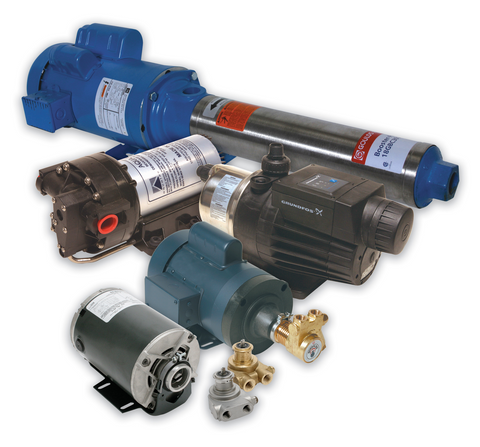
A chemical injection pump meters and delivers a controlled amount of chemical into a water stream or treatment process. Applications include disinfection, pH adjustment, scale prevention, and corrosion control.
In a typical metering pump, the suction stroke draws chemical from a storage tank into the pump head. During the discharge stroke, the pump pushes the measured volume through a discharge line and injection valve into the process stream. Check valves regulate flow direction, while a diaphragm, piston, or plunger provides the pumping action, depending on the design. Controls may adjust the dosing rate manually or automatically.
Unlike a general-purpose transfer pump, a metering pump is designed to deliver measured quantities of fluid. Actual output depends on operating pressure, pump settings, and fluid properties. A maximum flow rating alone does not establish how much chemical the pump will deliver in service.
Where Are Chemical Injection Pumps Used in Water Treatment?
Chemical injection pumps deliver controlled doses for scale prevention, pH adjustment, disinfection, corrosion control, and industrial process-water treatment. Each application has different dosing requirements, chemical compatibility considerations, and control needs.
In reverse osmosis (RO) systems, antiscalant dosing helps limit mineral scale formation on membrane surfaces. The pump must deliver the recommended dose at the required operating pressure. For pH adjustment, acids or alkalis are added to bring water within the target pH range, making dosing accuracy and material compatibility important.
For water disinfection, pumps inject chemicals such as sodium hypochlorite to help control microorganisms. The required dose depends on water quality and the treatment objectives. Corrosion control may involve feeding inhibitors to protect pipes and equipment, with pump materials selected to withstand the chemical being used.
In industrial water treatment processes, dosing or chemical injection systems may support process-specific treatment and water quality requirements. The appropriate pump depends on the chemical, required feed rate, operating pressure, and whether dosing must respond to changing process conditions.
What Types of Chemical Injection Pumps Are Available?
The main types of chemical injection pumps include diaphragm, peristaltic, piston, and plunger designs. The suitable option depends on the required flow rate, discharge pressure, chemical properties, dosing accuracy, and maintenance requirements.
Diaphragm Metering Pumps
A diaphragm metering pump uses a flexible membrane to move a measured volume of chemical. The diaphragm separates the fluid from the drive mechanism, reducing the risk of leakage into the mechanical assembly. These pumps are widely used for water treatment applications such as antiscalant injection, pH adjustment, and disinfection. Confirm that the diaphragm and pump-head materials are compatible with the chemical.
Peristaltic Dosing Pumps
A peristaltic dosing pump moves fluid through flexible tubing compressed by rotating rollers or shoes. The chemical contacts only the tubing, which can simplify cleaning and fluid isolation. However, tubing wears over time and must be compatible with the chemical, operating pressure, and temperature.
Piston and Plunger Metering Pumps
Piston and plunger pumps use a reciprocating component to draw in and discharge fluid. Depending on the design, they may suit applications requiring higher discharge pressures or specific metering characteristics. Seal wear, potential leakage, and chemical compatibility should be considered during selection.
How Do You Choose Between Chemical Injection Pump Types?
Compare the required flow rate and discharge pressure, then assess chemical viscosity, corrosiveness, and solids content. Consider dosing accuracy, control options, maintenance intervals, and replacement-part availability. Diaphragm pumps suit many routine dosing applications, while peristaltic and piston or plunger designs may fit different fluid and pressure requirements. Verify the final choice of your injection pumps against the manufacturer's performance curves and material specifications.
How Do You Size a Chemical Injection Pump?
Chemical injection pump sizing requires the process flow rate, target chemical dose, dosing-solution concentration, and discharge pressure. The selected pump must deliver the calculated solution feed rate under actual operating conditions, not merely meet a maximum gallons-per-hour (GPH) rating.
How Do You Calculate the Chemical Feed Rate?
To size a chemical injection pump, calculate the amount of active chemical required per day, then convert that requirement into the volume of dosing solution the pump must deliver. For US water treatment applications, use water flow in gallons per minute (GPM), chemical dose in parts per million (ppm), and pump capacity in gallons per day (GPD).
Step 1: Calculate the active chemical requirement
For dilute water-based applications, use this formula:
Active chemical required (lb/day) = Water flow (GPM) × Chemical dose (ppm) × 0.012
For example, assume a system treats 50 GPM of water and requires a chemical dose of 4 ppm.
50 × 4 × 0.012 = 2.4 lb/day of active chemical
The system requires approximately 2.4 pounds of active chemical per day. However, the pump delivers a dosing solution, not necessarily pure active chemical. The solution concentration must therefore be included in the next calculation.
Step 2: Calculate the active chemical concentration in the solution
Suppose the dosing solution contains 10% active chemical by mass and has a density of 1.1 kg/L.
- Solution density: 1.1 kg/L, equivalent to approximately 9.18 lb per US gallon.
- Active chemical concentration: 10% by mass.
- Active chemical per gallon: 9.18 × 10% = 918 lb/US gal.
Each gallon of dosing solution contains approximately 0.918 pounds of active chemical.
Step 3: Calculate the required pump feed rate
Divide the daily active chemical requirement by the amount of active chemical in each gallon of solution.
Required feed rate (GPD) = Active chemical required (lb/day) ÷ Active chemical concentration (lb/US gal)
2.4 lb/day ÷ 0.918 lb/US gal = 2.61 GPD
The pump must deliver approximately 2.6 gallons per day of the prepared dosing solution under the assumed conditions.
Metric equivalent: The water flow is approximately 11.36 m³/h, and the dose is 4 mg/L. This corresponds to approximately 1.09 kg/day of active chemical. With the same 10% dosing solution and density of 1.1 kg/L, the required solution feed rate is approximately 9.9 litres per day, or 0.41 litres per hour.
These figures are calculated values before any application-specific design margin. Confirm the recommended dose, solution concentration, and density before selecting a pump. Finally, verify that the pump can deliver the required feed rate at the actual discharge pressure.
How Do You Determine the Required Discharge Pressure?
The pump must overcome the pressure at the injection point and the resistance created by piping, valves, fittings, and other components. Account for elevation changes where relevant. The selected pump must deliver the required flow at this operating pressure, not just at zero or low backpressure.
How Do You Verify Pump Capacity and Chemical Compatibility?
Check that the pump can deliver the calculated feed rate at the required discharge pressure. Review its operating range and turndown ratio, which describes the range between maximum and minimum controllable output. An oversized pump may struggle to maintain accurate dosing when the required feed rate is very low.
Verify that the pump head, diaphragm or tubing, seals, check valves, and injection fittings are compatible with the chemical's concentration and temperature. Viscosity, specific gravity, and suspended solids can also affect performance.
Use the manufacturer's performance curves and material specifications to confirm capacity under the intended operating conditions.
For example, the calculated feed rate above is approximately 2.3 GPD. AXEON Supply lists 4 GPD Chem-Tech XP injection pumps that may be suitable for evaluation. Before selecting a model, verify its minimum controllable feed rate, actual output at the required discharge pressure, and compatibility with the dosing chemical.
Explore the chemical injection pump collection to compare available models and specifications.
How Do You Select a Metering Pump for RO Systems?
A metering pump for reverse osmosis (RO) systems must deliver the required chemical dose at the actual injection pressure. Selection depends on feed-water flow, chemical type, solution concentration, injection location, and the method used to control dosing.
Antiscalant dosing is a common RO pretreatment application. Antiscalants help limit scale formation on membrane surfaces, but the required dose depends on source-water chemistry, membrane system design, and the chemical manufacturer's recommendations. There is no universal dose for every RO system.
Calculate the required solution feed rate using the system's operating flow and recommended dose. Then confirm that the pump can maintain this output against the pressure at the injection point. Check the injection line, valves, fittings, and wetted materials for compatibility with the chemical.
The control method also matters. A fixed-rate pump may suit stable operating conditions, while flow-paced or automated dosing may be appropriate when feed flow varies. Consult the membrane system and chemical manufacturers' specifications before finalizing pump capacity and dosing settings.
What Causes Chemical Injection Pumps to Deliver Inconsistent Flow?
Chemical injection pumps may deliver inconsistent flow because of loss of prime, air in the suction line, clogged check valves, suction restrictions, leaks, or calibration drift. Identifying the cause can help restore accurate dosing without replacing a pump unnecessarily.
Common symptoms can point to specific checks:
-
Pump runs but delivers no chemical: Check the chemical supply, suction line, and prime. An empty tank or air leak may interrupt flow.
-
Flow is lower than expected: Inspect check valves for deposits, check for restricted tubing, and verify the discharge pressure.
-
Dosing fluctuates: Check for air or gas binding, worn components, and incorrect calibration.
Before servicing, isolate the pump, relieve pressure, and follow the manufacturer's instructions for safe chemical handling. Inspect valves, seals, and tubing for wear, and recalibrate the pump if necessary. If the problem persists, compare actual output with the manufacturer's specifications before deciding whether repair or replacement is appropriate.
How Do You Choose the Right Chemical Injection Pump and Supplier?
Choosing a chemical injection pump requires matching the required feed rate, discharge pressure, chemical compatibility, and control method to the application. A reliable supplier should also provide clear specifications, performance data, replacement parts information, and relevant application guidance.
What Chemical Injection Pumps and Systems Are Available at AXEON Supply?
AXEON Supply offers chemical injection pumps, tank-and-pump dosing systems, replacement pump tubing, and RO antiscalants for water treatment applications. Its catalogue includes the following product options:
Chemical Injection Pumps
The chemical injection pump collection includes Pulsafeeder Chem-Tech XP models rated at 4, 15, and 30 GPD, along with Series 100 models rated at 15 and 30 GPD. Available voltage configurations vary by model, including 110V and 220V options. Replacement pump tubes are also available.
Chemical Injection Systems
The chemical injection systems collection includes AXEON tank-and-pump systems with 30- or 50-gallon tanks. The listed configurations cover 4, 15, and 30 GPD dosing capacities, with 110V or 220V options depending on the model.
RO Antiscalants
The antiscalant collection includes AXEON S-200 and S-200C formulations in 5- and 55-gallon containers. The appropriate formulation and dose depend on feed-water chemistry, membrane system design, and the chemical manufacturer's recommendations.
These products are worth evaluating for RO antiscalant dosing and other applications within their rated capacities and operating limits. The listed range focuses on dosing capacities from 4 to 30 GPD. For higher flow requirements or applications with different pressure demands, contact AXEON Supply to discuss available options.
Confirm the selected model's suitability against the manufacturer's specifications before purchasing.
How Do You Evaluate a Chemical Injection Pump Supplier?
A reliable supplier should offer clear warranty terms, access to replacement parts, technical support, and product documentation. Evaluate these factors before purchasing.
- Warranty and returns: Review terms and conditions and return policy to understand coverage, exclusions, and claim procedures.
- Replacement parts: Check the injection pump collection and confirm the availability of model-specific replacement components.
- Technical support: Use customer support to discuss pump selection, compatibility, and application requirements.
- Product documentation: Review product specifications and the FAQs for information on ordering and fulfilment.
- Delivery: Check the shipping policy for shipping terms and confirm current availability and delivery estimates.
Before requesting a quotation, prepare your required feed rate, operating pressure, chemical details, electrical requirements, and control needs. Confirm that the proposed pump meets these requirements before ordering.
Need a chemical injection pump or dosing system for your water treatment application? Visit AXEON Supply to discuss your flow rate, operating pressure, chemical compatibility, and equipment requirements with the team.